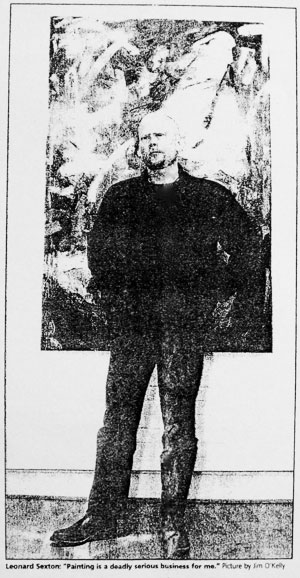
‘I paint a lot of female figures…’
‘My basic philosophy in life is tenacity of purpose, as Samuel Beckett put it. If work is going well, I’ll get up at 6am, keen to get back to whatever image I’m working on. There’s a feeling of euphoria if work is going well, a despondency if it isn’t.
I try to get into the studio as quickly as possible, conscious of breaking my train of thought.
Breakfast is a bowl of cereal or juice. I can’t seem to be bothered peeling fruit and eating it so I throw it in the juicer instead. Even though I have to clean the juicer afterwards, it just seems easier.
If I’ve been out with artists David Newton and Eugene McGowan the night before – drinking, smoking and arguing about painting – I’ll stop off at a café on the way home and have a large fry-up. I’ll probably be a little hungover and will have brown bread rather than white toast, which equals heartburn.
If work isn’t going well, I get up later and put it off a bit longer. I’ll wash the car, do the shopping, clean the house, smoke cigarettes and drink a lot of tea, then march up and down, just waiting.
I talk to myself a lot as well, particularly if I’ve just had a moment of enlightenment. I talk out loud to myself about what I’m doing. Someone noticed it recently and I was a bit surprised. I just told them they were hearing things, that I hadn’t said a word!
I started painting in my teens and stood up in the early ’80s and said I wanted to be a full-time painter, which was virtually unheard of at the time. If you’re going to paint full-time, you have to force yourself – you can’t really sit around, waiting for inspiration. As the old saying goes, it’s 90pc perspiration.
Once I’m in the studio I change into working clothes, usually forgetting that every stitch of clothing has paint on it. Organising light might sound strange but that’s the next thing I do. At this time of year I use a mixture of natural and artificial light. The heaters go on and palettes, brushes and knives are cleaned or replaced.
I paint a lot of female figures but I don’t use models. I paint from the memory of individuals I’ve met, personal relationships and my own experience, limited as that may be.
It’s not so bad if I’m starting a new painting but, if I’m halfway through one, it’s quite difficult to come back to an image with the same level of concentration I had when I left it. Generally, I’m conscious of avoiding exercise but sometimes I’ll go out for a walk, coming back to look at what I’ve done with a fresh eye. But while I’m working, the idea is never to take my eye from the image; I’m always making calculations.
If I’m working at home in Leitrim, the kitchen is right next to the studio. I have a sandwich, make a few calls and smoke a few cigarettes. Years ago my brother used to phone my mother and say: ‘Is Leonard still surviving on sandwiches?’ Nowadays I love good food but will eat everything and anything. I often think my work is like that of a cook – I spend the whole day squeezing things out, preparing and organising things.
At this time of the year I stay in the studio until dark, sometimes much later if things are going well or if something needs to be finished for an exhibition or commission. I’m usually physically and mentally exhausted at the end of the day so things get left where they fall.
I’m quite a physical painter. Don’t imagine me delicately working with a sable brush, picking away like Velasquez in the corner. I’m more expansive and use quite big brushes. I make sure I put my brushes in water; even without cleaning them first, it’s a good thing to do. At €40 a pop, you have to take care of them.
Painting is a deadly serious business for me – an intense, emotional experience – and I try to bring an honesty to my work. I think that rubbed off on me from Paddy Graham, whose blunt honesty was quite an assault on the senses of an 18-year-old student in the ’80s but which has stood to me. I don’t like pretty images. I like images that make an argument with you, that confront you.
At the moment I’m living mostly in Leitrim, coming back to Dublin for exhibitions. Leitrim is just so reasonable compared to Dublin. I’m paying €350 a month for a small house and studio in Ballinamore whereas I enquired about a studio in Temple Bar recently and was told it would cost €1,000 a month. Those kinds of prices are really forcing artists out of Dublin – ironically, in a part of the city that 20 years ago only artists would work or live in.
If I’m in Leitrim, I like to relax after work with a nice, long bath. I cook something relatively simple like pasta, chicken or steak and stir-fried vegetables – nothing that takes too much preparation. Then I like to meet friends and family for a chat. I’m isolated all day so when I come out of the studio I like to make up for it.
One of the nice parts of my work is having a pint of Guinness with other artists. Art can be a devastating business but I love bouncing off other artists and discussing ideas with them. In Dublin we go to the Pembroke Inn across from the Blue Leaf gallery. Of course it’s full of ‘suits’ but isn’t every pub in Dublin these days?
I’ve worked really hard over the last few years and, to be honest, work does take over other parts of your life – which explains why I’m single at the moment. Things have picked up in the last few years and work has become central. I would love a son and daughter at some stage but there’s plenty of time – I’ll get around to it!
I suppose I do obsess about art but I’m not the kind of person who goes to all the shows around town. I can’t stand the mingling and mixing; there’s a falseness to it. I can barely be dragged out to my own shows. When I am, I hang around for half an hour, then leave. As far as I’m concerned, the images speak for themselves.
Somehow, without doing any networking whatsoever, my images seem to be appreciated anyway. It is nice to have a chat with people who are genuinely interested in the work but I would far prefer to meet them somewhere else on another day for a chat.
There’s been a surge of interest in my work recently. I put it down to the simple fact that my work has improved. I’m much closer now to painting the kinds of images I wanted to paint when I was younger but wasn’t physically or mentally able to.
Four large paintings in the catalogue sold at about €5,500 each before the show opened, which was great. It’s nice to be able to sell your paintings, to get them out there and see that they’re understood. But I don’t necessarily care who buys them. Of course, if Bono walked in tomorrow and bought one, that attitude might change.
I remember an artist called Clement McAleer, a big name in London, telling me once: ‘Keep everything you’ve ever painted.’ To which I replied: ‘It’s a bit late now.’ I burnt a lot of my early stuff years ago. I suppose because, subconsciously, I thought it was miles away from what I wanted to be painting, what I wanted to say through my work.
I do occasionally walk in somewhere and see one of my paintings hanging in a public place but I usually try to avoid those places. Mostly I’m happy with what I see but sometimes I think: ‘Oh no, not that one. That’s not finished. Let me take it away for a week, finish it for you and bring it back.’”
In conversation with
Catherine Murphy